 BEAUTY IN EVERY DETAIL
To work out how many tiles you need, measure the area in metres, add 10% for wastage, then divide by the coverage of one tile. For a 2.4m x 2.0m bathroom floor that is 4.8 m², which becomes 5.28 m² with wastage — or 30 tiles at 60 x 30cm. Order 10% extra for straight layouts, 15% for herringbone or patterned designs, and always buy the full quantity in one batch so the shade matches.

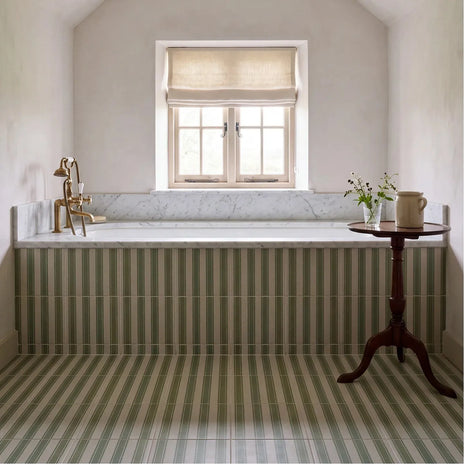
When calculating how many tiles you need, the tile size and coverage per box are important starting points. Our Ca' Pietra Sanderson Pinetum Stripe Sage is a 20 x 20cm matt porcelain tile, with 15 tiles covering 0.6m² per box. The small square format works particularly well for creating patterned layouts, so remember to allow extra tiles for cuts and wastage.
Getting this number right matters more than it sounds. Order short and you risk a second batch in a visibly different shade; order wildly over and you have paid for tiles you will never lay. Here is the method our showroom team uses, plus a worked example you can copy.
Key Points
- Measure each floor and wall in metres, then add the areas to find the square metres to tile.
- Allow 10% for straightforward layouts, 15% for patterned layouts, or 20% for large-format tiles and natural stone.
- Divide by the tile or box coverage, round up to whole boxes, and order from one batch.
How do you calculate how many tiles you need?

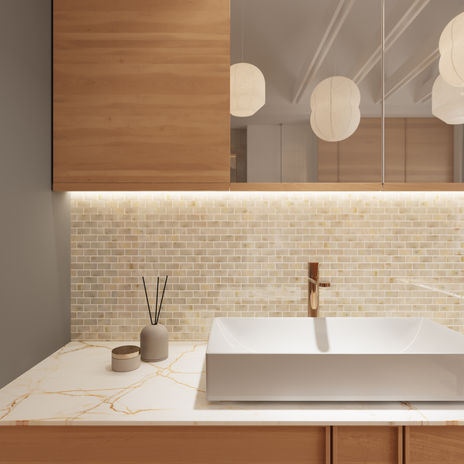
Mosaic tiles are usually supplied in sheets, so it’s important to calculate your required coverage rather than simply counting individual pieces. Our Calacatta Sugar is a natural marble mosaic with a polished finish, supplied on 30.5 x 30.5cm mesh-backed sheets. Each box contains five sheets covering 0.47m², so measure your area, divide by the box coverage and remember to allow extra for cuts, wastage and future repairs.
Step 1: Measure each area in metres
For floors, measure length x width. For walls, measure width x height. Working in metres means your answer comes straight out in square metres, with no converting.
Measure each wall separately rather than treating the room as one big rectangle — bathrooms and kitchens are rarely square, and alcoves, chimney breasts and boxed-in pipework all change the figure.
Step 2: Add the areas and subtract the big openings
Add everything together, then subtract anything over roughly 1 m² that will not be tiled: a door, a window, a shower tray. Leave small obstacles like sockets, basins and radiators in your total — you will cut around them, and the offcuts are rarely reusable elsewhere.

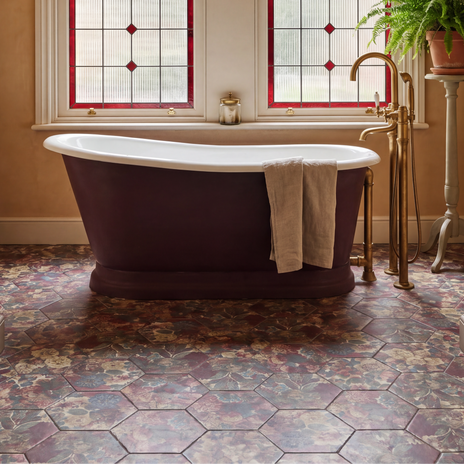
Patterned and hexagonal tiles need a little extra consideration when calculating quantities, as more cuts may be required around the edges of a room. Our Ca' Pietra Sanderson Very Rose & Peony Madder is a matt porcelain tile measuring 20 x 20cm, with 32 tiles per box covering 0.98m². As a general guide, allow around 10% extra for cuts and wastage when working out how many boxes you need.
Step 3: Add wastage
Every job produces cuts, and some tiles break. Add:
- 10% for a straight or brick-bond layout in a simple rectangular room.
- 15% for herringbone, diagonal, chevron or patterned designs, and for rooms with lots of corners and alcoves.
- 20% for very large format tiles, or natural stone where you may reject the odd piece on colour.

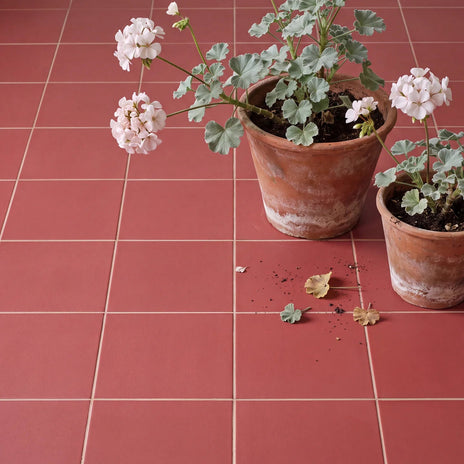
Using two colours together doesn't change the overall area you need to cover, but it does mean you need to calculate the quantity of each colour separately. Both Sanderson Plain Madder and Plain Dove Blue are matt porcelain tiles measuring 20 x 20cm, with each box containing 15 tiles covering 0.6m². When creating a pattern, allow additional tiles for cuts and keep a few spare for future repairs.
Step 4: Convert square metres into tiles or boxes
A single tile's coverage is its length x width in metres. A 60 x 30cm tile is 0.6 x 0.3 = 0.18 m². Divide your total by that figure for the number of tiles, or by the box coverage for the number of boxes.
Step 5: Round up, and order in one batch
Always round up to whole boxes — tiles are almost never sold loose. And order the full quantity at once. Tiles are made in production batches, and shade can vary noticeably between them, so a top-up order weeks later may not match.
How many tiles are in a square metre?
Use this table to convert square metres into tile counts for the most common UK sizes.
| Tile size | Coverage per tile | Tiles per m² |
|---|---|---|
| 10 x 10cm | 0.01 m² | 100 |
| 20 x 10cm (metro) | 0.02 m² | 50 |
| 15 x 15cm | 0.0225 m² | 44.4 |
| 20 x 20cm | 0.04 m² | 25 |
| 30 x 30cm | 0.09 m² | 11.1 |
| 60 x 30cm | 0.18 m² | 5.6 |
| 60 x 60cm | 0.36 m² | 2.8 |
| 75 x 75cm | 0.5625 m² | 1.8 |
| 120 x 60cm | 0.72 m² | 1.4 |
For any size not listed, divide 1 by the tile's area in square metres.

Large-format tiles can cover an area quickly, but don't forget to account for the cuts required around edges, corners and fixtures. Our Ca' Pietra Rialto Porcelain Cognac measures 60 x 60cm, with four matt porcelain tiles covering 1.44m² per box. For this tile, Hyperion recommends allowing around 10% extra for cuts and wastage before ordering.
A worked example: a full bathroom
Take a 2.4m x 2.0m bathroom with a 2.4m ceiling, tiled floor-to-ceiling on three walls, using a 60 x 30cm porcelain sold in boxes of six tiles (1.08 m² per box).
| Area | Calculation | Result |
|---|---|---|
| Floor | 2.4 x 2.0 | 4.80 m² |
| Wall 1 (2.4m wide) | 2.4 x 2.4 | 5.76 m² |
| Wall 2 (2.0m wide) | 2.0 x 2.4 | 4.80 m² |
| Wall 3 (2.4m wide) | 2.4 x 2.4 | 5.76 m² |
| Less door and window | Subtract | −2.00 m² |
| Total tiled area | 19.12 m² | |
| Plus 10% wastage | 19.12 x 1.10 | 21.03 m² |
| Tiles needed | 21.03 ÷ 0.18 | 117 tiles |
| Boxes to order | 21.03 ÷ 1.08 = 19.47 | 20 boxes |
Twenty boxes gives 21.6 m² — a comfortable margin over the 19.12 m² you actually need, with a few spares left over for future repairs. That last point is worth taking seriously: keeping half a box in the loft is the cheapest insurance there is against a cracked tile in five years' time.

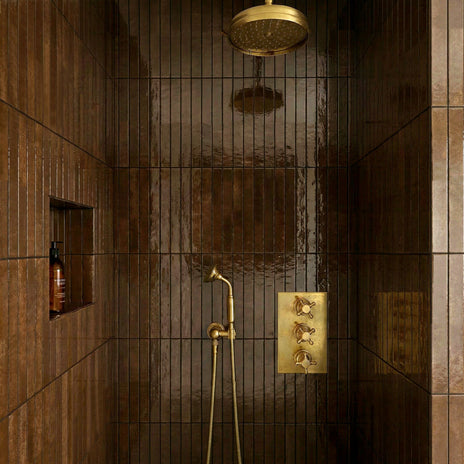
Slim, elongated tiles such as our Waxman Ceramics Arta Chocolate can require a little more thought when calculating quantities, particularly when they are being installed in a more intricate layout. Made from porcelain with a polished finish, these 5 x 45cm tiles are sold individually, with 44.44 tiles required to cover 1m² before allowing for cuts and wastage.
Design Tip: Keep a few matching tiles after installation for future repairs; a later batch may differ in shade.
Three things that catch people out
- Box coverage varies by range. It is commonly between 1 and 1.5 m², but never assume — check the figure on the specific product page before you divide.
- Grout joints do not reduce your tile count. Tile sizes are nominal and joints are only 2–3mm, so the standard calculation already works. Do not try to adjust for them.
- Mosaic is sold by the sheet, not the tile. Work in sheet coverage (usually around 30 x 30cm, or 0.09 m²) rather than counting individual chips.
Frequently asked questions

Long, slim formats can create a striking linear effect, but their unusual dimensions make accurate measuring particularly important. Our Waxman Ceramics Genesi Anthracite Brillo is a 4.8 x 45cm glazed porcelain tile with a gloss finish, supplied in boxes of 32 tiles covering 0.68m². When working out your total, remember to factor in cuts and wastage rather than ordering for the exact measured area.
How do I work out how many tiles I need?
Measure the area in metres (length x width for floors, width x height for walls), add 10% for wastage, then divide that figure by the coverage of one tile or one box. Round up to whole boxes. For example, a 4.8 m² floor plus 10% wastage is 5.28 m², which is 30 tiles at 60 x 30cm.
How many tiles do I need for my bathroom?
Measure the floor and each tiled wall separately, then add them together. An average UK family bathroom works out at roughly 15–22 m² of tiling in total if the walls are tiled full height, or 5–8 m² for a floor and single shower wall. Add 10% wastage on top before converting to tiles.
How many wall tiles do I need?
Multiply the width of each wall by the height you intend to tile, in metres, and add the walls together. Subtract doors and windows over about 1 m², then add 10%. A 3m wide wall tiled to 2.4m is 7.2 m², or 7.92 m² once wastage is included.
How many boxes or packs of tiles do I need for a room?
Divide your total square metres including wastage by the coverage printed on the box, then round up. Box coverage varies by range, commonly 1–1.5 m², so always check the specific product rather than assuming. Five boxes at 1.08 m² covers 5.4 m².
How many extra tiles should I order for wastage?
Order 10% extra for straight and brick-bond layouts, 15% for herringbone, diagonal or patterned designs, and 20% for very large format tiles or natural stone. Rooms with lots of corners, alcoves and cuts sit at the higher end of each range.
How many tiles are there in a square metre?
It depends entirely on the tile size. There are 100 tiles per m² at 10 x 10cm, 25 at 20 x 20cm, 50 at 20 x 10cm metro, about 5.6 at 60 x 30cm, about 2.8 at 60 x 60cm, and about 1.4 at 120 x 60cm. Divide 1 by the tile area in square metres to work out any size.
Got your number? Here is where to start looking

Large-format tiles can cover a surprisingly large area with each individual tile. Our Lapicida Antique Marble Effect Calacatta Oro is a matt porcelain tile measuring 60 x 120cm, with each tile covering 0.72m². Sold individually, it’s important to calculate the total area carefully and then allow around 10% extra for cuts and breakages when working out how many tiles you need.
Browse our porcelain tiles for hard-wearing walls and floors, our large floor tiles if you want fewer grout lines, or our mosaic tiles for feature areas. Every product page lists the tile size and box coverage you need for the calculation above — and if you would rather have someone check your figures, bring your measurements into our Ascot showroom and our team will work it through with you.
Share:
How Much Does It Cost to Tile a Bathroom? (2026 UK Guide)